
Mario Tama/Getty Images
- Brent crude jumped to over $115 a barrel early on Monday before paring some of its gains.
- Weekend military strikes had rattled markets, but suggestions of peace talks by Trump calmed fears.
- Gas prices in the US are now averaging almost $4 per gallon.
Oil prices rose on Monday after President Trump leveled fresh threats against Iran but said a peace deal was close, and Iran-backed Houthis in Yemen launched cruise missiles and drones at Israel, marking their entry into the war.
As of 10 a.m. in New York, May contracts for Brent crude were trading 1% higher at just under $114 per barrel, after approaching $117 earlier in the session.
May contracts for West Texas Intermediate (WTI) were up 2.5% at $102 a barrel, after clearing $103 earlier in the day.
In an early Monday post, Trump wrote on Truth Social that the US was close to striking a deal with Iran to end the weeks-long conflict.
But he warned that if the agreement falls apart and the Strait of Hormuz isn't immediately reopened, the US will "conclude our lovely 'stay' in Iran by blowing up and completely obliterating all of their Electric Generating Plants, Oil Wells and Kharg Island."
The world leader said it would be "retribution" for Iran's killing of American and other soldiers over a nearly 50-year period.
Trump had previously told the Financial Times on Sunday that he wanted to "take the oil in Iran," and suggested he could seize the export hub of Kharg Island.
"To be honest with you, my favourite thing is to take the oil in Iran, but some stupid people back in the US say: 'Why are you doing that?' But they're stupid people," Trump told the newspaper.
"Maybe we take Kharg Island, maybe we don't. We have a lot of options," he added.
Trump said taking that approach would mean "we had to be there for a while."
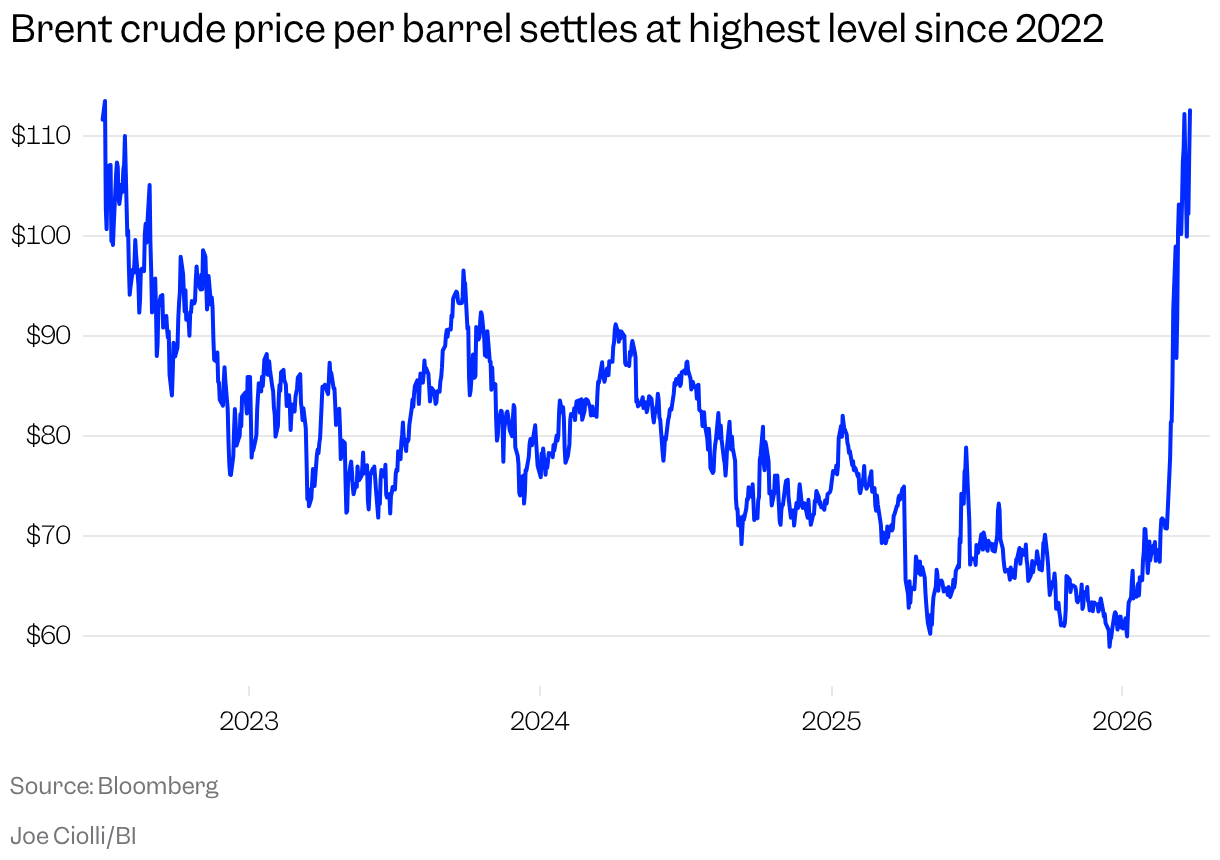
Oil prices have surged since the US and Israel began bombing Iran at the end of February, and Iran retaliated by essentially closing the Strait of Hormuz.
About 20% of the world's oil supply and liquified natural gas passes through the waterway off Iran's coast. Major oil hubs across the Middle East have also been damaged during the conflict, further straining the global supply chain.
The Houthis launched two missile and drone attacks at Israel over the weekend. Yahya Saree, the spokesman for the Yemeni Armed Forces, confirmed the attacks on X.
For American consumers, this all translates to higher gas prices. The national average in the US was $3.99 on Monday, up from $2.98 in February. The International Energy Agency has released 400 million barrels of oil from a strategic reserve to ease economic uncertainty.
Although US Energy Secretary Chris Wright said on March 8 the war wouldn't be "long-term," the Trump administration and Iranian officials have not yet signaled an exit plan.
On Saturday, The Washington Post reported that the Pentagon is preparing for weeks of ground operations in Iran.
The developments over the weekend weighed on the stock markets, with Asian markets closing broadly lower on Monday.
Japan's Nikkei 225 and South Korea's Kospi indexes both lost around 3%, after dropping 5% earlier in the day. Hong Kong's Hang Seng Index was down about 0.9%.
However, European stocks traded higher on Monday with Germany's DAX up 0.8%, Britain's FTSE 100 up 1.5%, and France's CAC 40 up 0.75%.
US markets were mixed in the first 90 minutes of trade, with the Dow Jones up roughly 0.5% or 230 points, and the S&P climbing 0.2%. The tech-focused Nasdaq was virtually unchanged.
Gold was trading about 1% higher at $4,570 per troy ounce, while silver was up 1.8% at $71.03.
"Market nervousness around the situation in the Middle East continues to ratchet up as the Iran conflict enters a fifth week," Danni Hewson, AJ Bell's head of financial analysis, said in a morning note.
"Comments from President Trump about seizing Iranian oil and the country's Kharg Island export hub, a build-up of US troops and the involvement of Tehran-backed Houthis in the war all create the impression of a conflict that is escalating rather than drawing to a close," Hewson added.