
Luis Alvarez/Getty Images
- A new analysis of job postings showed demand for AI knowledge goes beyond software development gigs.
- Management and marketing roles are among those making up a higher share of "AI-touched" job titles than a few years ago.
- It suggests employers want people with expertise in their line of work and additional AI fluency.
If you've been avoiding AI, it might be time to get familiar with what it can do in the workplace.
The share of Indeed job postings containing AI terms has skyrocketed over the past year. And job titles mentioning AI aren't limited to just tech.
A new analysis from Pawel Adrjan, senior director of economic research for Europe, the Middle East, and Africa at the Indeed Hiring Lab, examined "AI-touched" job titles, defined as those with at least five postings mentioning AI in the title in a specific quarter.
The analysis indicates the number of those titles has risen in the US from 264 in 2022, or 2.6% of titles with at least five job postings, to 822 in the first quarter of 2026, or 8.3%.
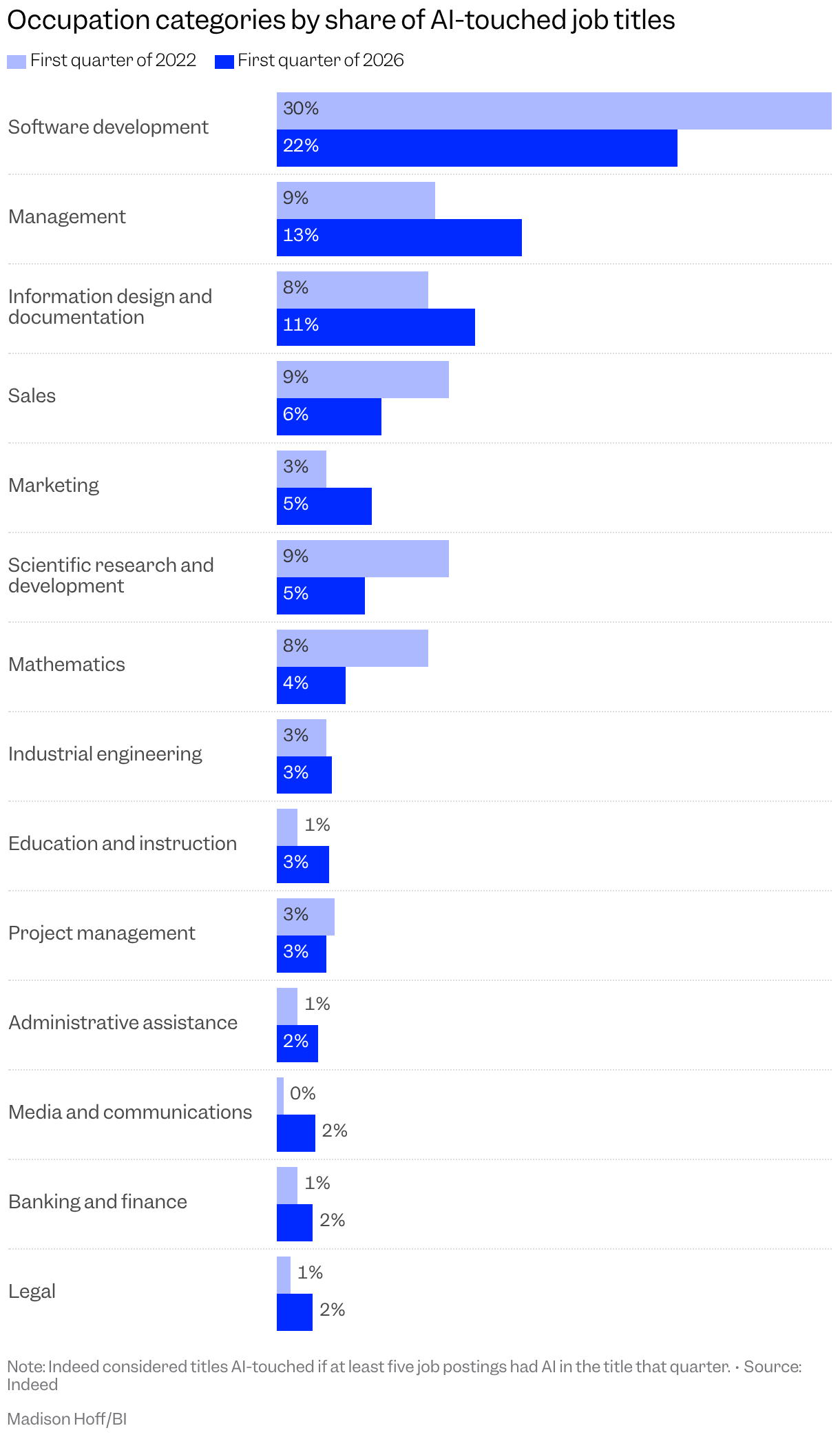
Sixty-three percent of AI-touched US job titles were non-tech. Software development accounted for the highest share of AI-touched job titles in the first quarter of 2026, as in 2022, but the share has declined as some other types of occupations have added AI to their titles.
Management, marketing, education, and instruction are among the occupational categories that have increased their share. That means employers are seeking people with both field and AI knowledge; a physical therapist using AI for documentation would still need to be skilled at helping patients while also familiar with the new systems.
In an interview with Business Insider, Adrjan compared this expansion of AI demand in the workforce to the previous broadening of computer skills beyond IT jobs.
"One pattern that stands out is that many of the roles with AI in the title are jobs that have existed for decades," Adrjan's report said. "Employers are not only hiring AI specialists, but they are also adding AI to the titles of jobs where the use of AI tools is required — an indication of how AI is already reshaping jobs."
Some examples include "AI Autonomous Truck Test Driver," "Physical Therapist (AI Documentation)," "AI Project Engineer," and "Electrical Engineer — Battery Systems for AI Data Centers."
Adding to the job rather than replacing workers
The "AI-touched" postings indicate that employers still want people to fill seats, even as roles start using the new tech.
"When a job title includes AI, what we see in the data is that it's more of a signal of demand than a signal of replacement," Adrjan said. "It really seems to capture employers who are wanting AI skills to be incorporated into the job, which looks a bit like augmentation."
Adrjan said mentions of AI in job titles don't mean people have to earn a computer science degree or acquire deep technical knowledge. Instead, it suggests employers want people with expertise in their field and AI fluency.
"That is reassuring for people who worry about AI because it's more about applying AI to the work that they already know and to the domain they already know, rather than having to switch into something completely different," Adrjan said.
A separate report by Guillermo Gallacher, an economist at Indeed Hiring Lab, showed changes in US job postings based on how exposed occupations were to AI. Gallacher said that "the more exposed to AI an occupation is, the more it declined" between May 2022 and May 2026, while the shorter span of May 2025 to May 2026 showed that "the more exposed to AI an occupation is, on average, the more it rebounded."
"The relationship between AI exposure and job postings appears to be flipping, from job destruction to job creation," Gallacher said.
Adrjan said the findings suggest AI augmentation, not necessarily AI creating jobs. He said that if people become familiar with AI tools, then it could open more doors for them in the labor market.
People can upskill on their own, but Adrjan said employers and educational institutions can also incorporate AI training, especially if a job requires specialized AI tools. That can help mitigate the risk of people falling behind.
"If AI competence continues to become an expectation across more occupations and across more jobs, then clearly there's a risk that some people may not be able to get the training or get familiarity with those tools as fast as others," Adrjan said.