
Marcin Golba/NurPhoto via Getty Images
- A Ryanair Boeing 737 Max's cabin window was "dislodged" during a flight between Greece and Germany.
- Several media outlets reported that a passenger was partially sucked out of the window.
- Ryanair said one passenger received medical help after the plane diverted to its departure airport.
A Ryanair passenger was injured after a cabin window was "dislodged" during a flight from Greece to Germany on Friday morning, the airline said.
Local media outlets reported that a 61-year-old man was sucked out of the plane up to his shoulders after a piece of the engine broke off and hit his window. One witness told local outlet Radio Thessaloniki that other passengers pulled him back inside the cabin.
Reuters also cited two industry sources as saying a passenger was partially sucked out of the window.
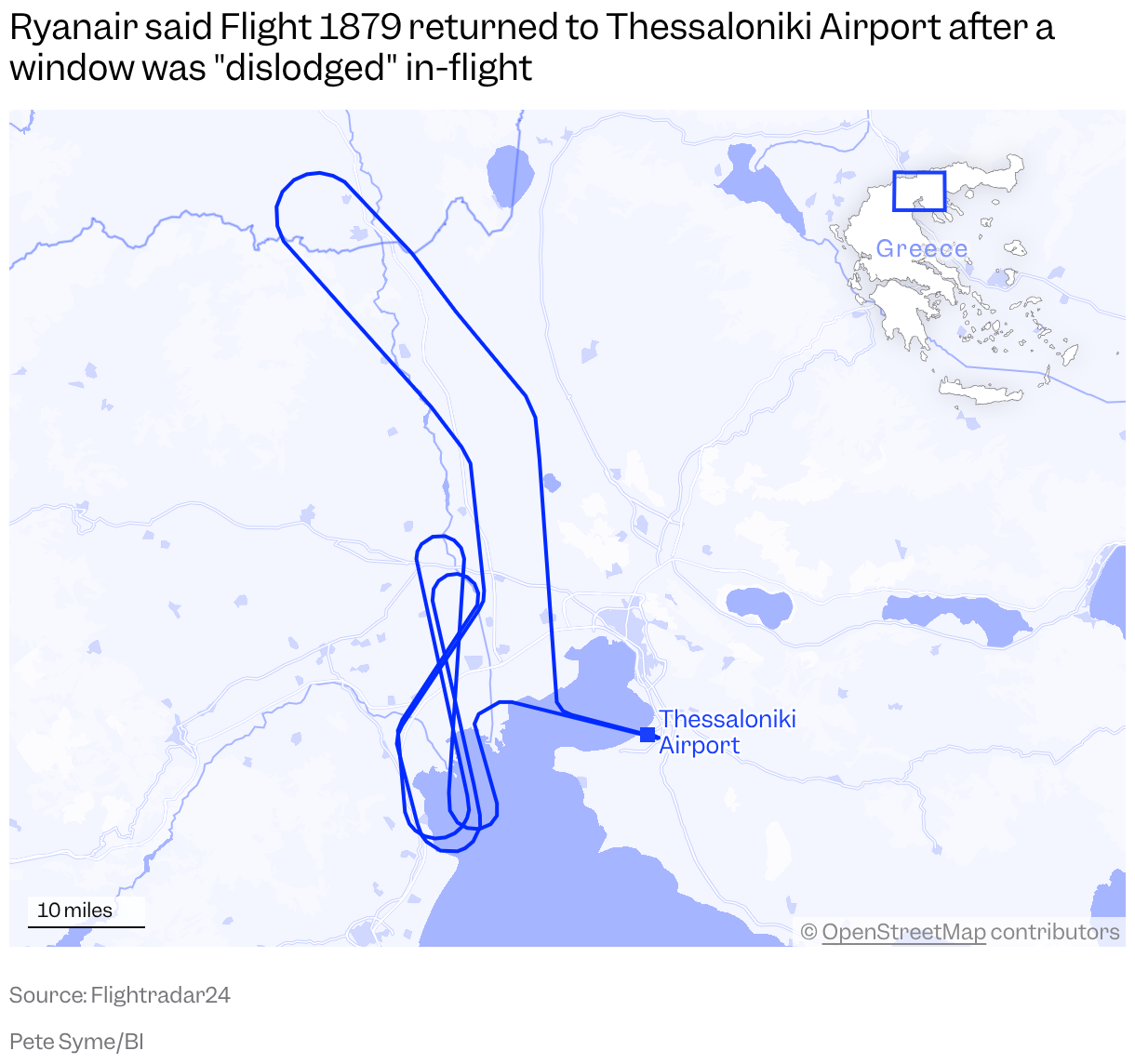
Flight 1879 departed Thessaloniki, Greece, at about 6 a.m. for Memmingen, Germany — a roughly two-hour flight. About 10 minutes after takeoff, the Boeing 737 Max U-turned before circling nearby and landing back at Thessaloniki.
Video and images published by Radio Thessaloniki showed the blown-out window and oxygen masks hanging from the ceiling. The missing window would have depressurized the cabin.
In a statement, a Ryanair spokesperson did not confirm reports of a passenger being partially pulled out of the plane, but did say that the plane U-turned "when a passenger window dislodged inflight."
It added that "one passenger requested and received medical assistance on the ground in Thessaloniki."
The plane landed normally, and a replacement aircraft operated a new flight, which departed at 9:53 a.m.
Passengers landed in Memmingen about four hours later than they were initially scheduled.
Similarities to Southwest Flight 1380
It's unclear what caused the window to separate from the plane, but engine debris striking the fuselage isn't unheard of.
In 2016, a fan blade on a Southwest Airlines 737 broke off due to metal fatigue, leaving a five-inch hole in the fuselage. No one was injured.
Two years later, Southwest Flight 1380 suffered a virtually identical uncontained engine failure when another fan blade escaped the engine, but this time struck a window, causing a passenger to be partially sucked out of the aircraft. She was pulled back inside but died from her injuries.
Both Southwest aircraft were Boeing 737-700s, the generation before the Max involved in the Ryanair incident, but all three jets use CFM56-7B26 engines.
After the fatal Southwest incident, US and European regulators mandated ultrasonic inspections of CFM fan blades for cracks, identifying more than a dozen affected engines globally.
Both aviation authorities also further tightened the inspection interval from every 3,000 flight cycles — one takeoff and landing — to every 1,600.
The stricter inspections don't completely eliminate the risk of metal fatigue, but they're designed to detect cracks early and reduce the chances of a catastrophic failure.