
Christian Rodriguez for BI
In his two decades as a Wall Street tailor, Michael Andrews learned to ignore clients who said they planned to get in shape. He only took them seriously when their weddings were approaching.
Over the past two years, however, many of his regulars — investment bankers, private equity executives, and the lawyers who serve them — have been returning to his NoHo shop with their suits hanging from much slimmer frames.
"We've had dozens of clients bring back entire wardrobes," Andrews said. "For a couple of clients, it's 20 to 40 pieces that we've had to take in because they've lost 20 to 30 pounds."
Those kinds of transformations used to be "exceedingly unusual," Andrews said. Now, they're commonplace. On Wall Street, Andrews said, "the Ozempic effect is real."
Christian Rodriguez for BI
GLP-1 drugs like Ozempic, Wegovy, and Mounjaro famously cause people to lose a lot of weight, and fast. Some studies show that people taking GLP-1s on average lose up to 15% of their body weight in a year.
A November 2025 poll of 1,350 people by the Kaiser Family Foundation found that 18% of Americans said they had ever used GLP-1 medications. About three-quarters said they used them to lose weight specifically, rather than treat diabetes or other medical conditions.
The booming weight-loss drug market is top of mind on Wall Street, with UBS projecting it will reach $126 billion by 2029, roughly double its size in 2025.
When COVID — and GLP-1s — moved the needle
Over the years, Andrews has seen clients gain and lose weight, and has kept track of major alterations — which he defines as jackets and pants being taken in or let out by at least two inches — to make sure adjustments are carried forward into future orders.
It's easier to make a garment smaller after major weight loss than to make it bigger after major weight gain, and clients who lose weight tend to be more comfortable returning to show the change, Andrews said.
That might partly explain why, in the eight years that Andrews has been collecting data, he found that for every two to four clients who had their suits taken in, one had theirs taken out.
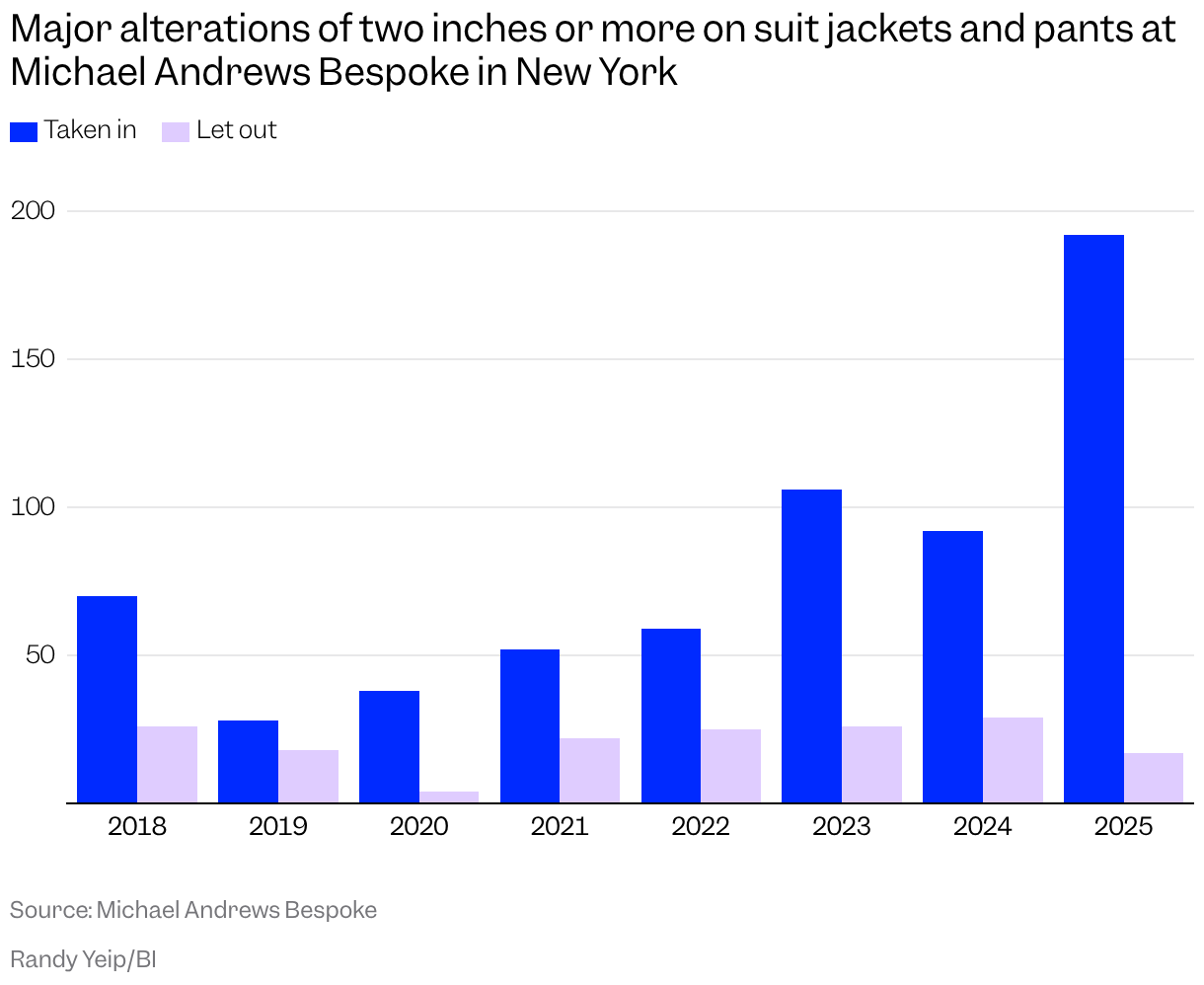
There were two big exceptions: 2020, when almost 10 times as many clients had their suits taken in as out. Andrews put it down to lifestyle changes, like his customers having fewer client dinners and drinking less during COVID. In the years that followed, the ratio returned to its normal range — until 2025, when for every suit Andrews took out, he took in 11.
In 2025, Andrews received 17 requests to enlarge garments, while he fielded 192 to make garments significantly smaller. That's more than double the 2024 total of take-ins, and five times the number of alterations during the 2020 spike.
The effects of GLP-1s go beyond slimmer customers — they've reshaped Andrews' business, too. To keep up with what he sees as the GLP-1 effect causing a surge in demand for alterations, Andrews said he added two additional tailors to his five-person team in 2025.
Christian Rodriguez for BI
Clients weigh what they did in high school
Alan Horowitz, who makes suits for men at Blackstone, BlackRock, Morgan Stanley, and other Wall Street institutions, similarly said the rise of GLP-1s has had a "dramatic impact on our business."
Horowitz's business offers free lifetime alterations, a policy that only about 2.5% of clients used to use, typically for adjustments of 3 inches or more. Last year, 16% took advantage of the offer, mostly to have their suits taken in. The average chest size of his clients in 2025 was down about 1.5 inches from 2023, he added.
On the one hand, alteration costs have surged, he said. The upside is that clients who lose weight tend to feel better about themselves and replace their wardrobes entirely rather than alter older suits.
"People are at weights that they haven't seen since college, and sometimes even high school," he said.
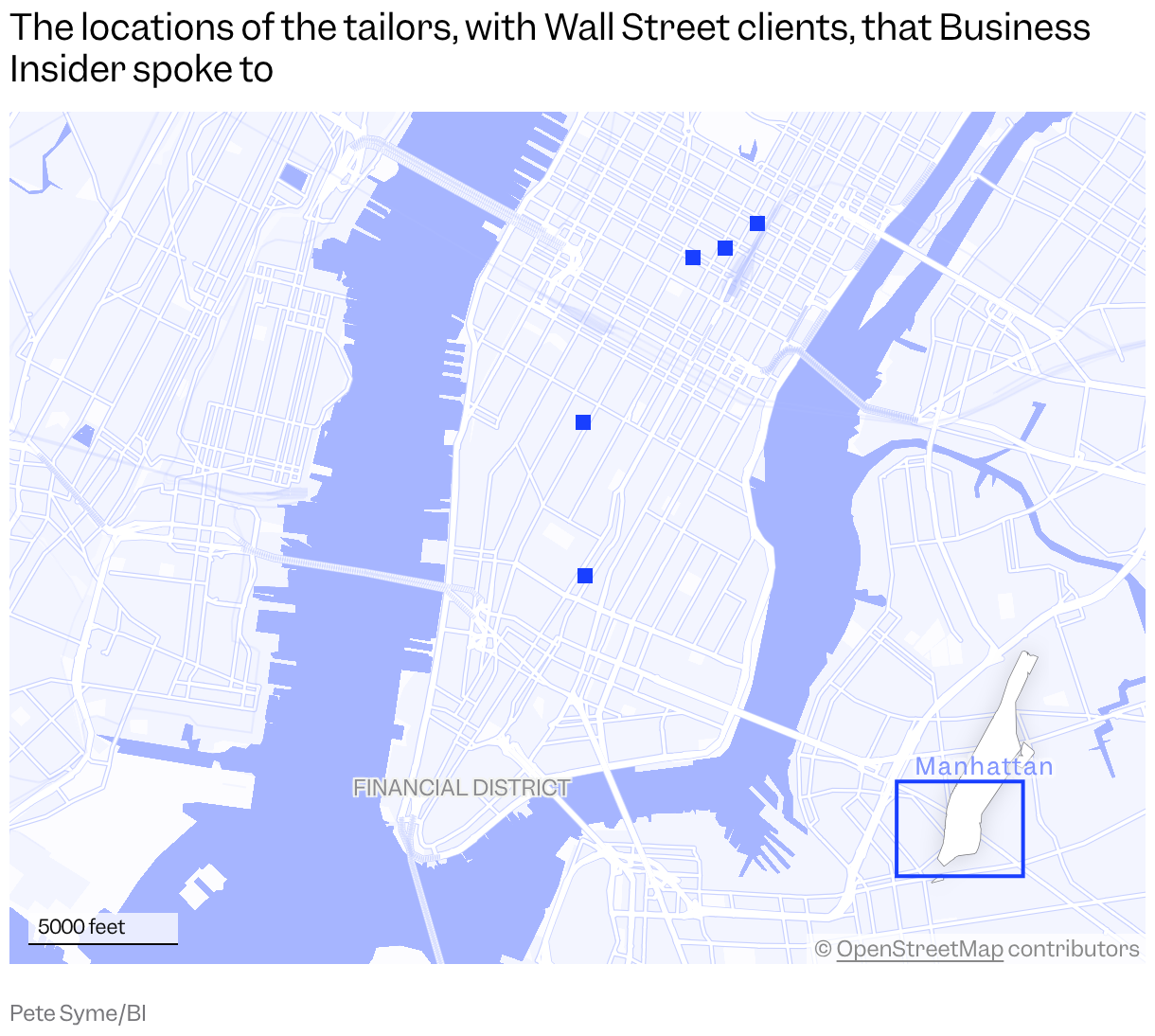
Elsewhere in the city, Jonathan Sigmon, the owner of Alan Flusser Custom on 48th Street and Fifth Avenue, said his store handled about 30% more alterations in 2025 than in 2024, and roughly double the number it did in 2023. Most were take-ins.
While many clients are now slimmer, Sigmon said only a handful of new clients are asking for fundamentally different cuts or "slim-fitting silhouettes." The majority want their existing clothes altered to fit their new body shapes.
"Most understand that our house style has a bit more ease, and is guided by the proper proportions meant to flatter the individual rather than follow current trends," he said.
Christian Rodriguez for BI
Other tailors, however, have seen a shift in style preferences in recent years. Israel Zuber, the owner of LS Mens Clothing on West 45th Street and Sixth Avenue, said his clients now ask for less shoulder padding, shorter jackets, and a trimmer overall fit.
Some of that reflects a more modern style, Zuber said, but it also serves another purpose: slimmer cuts tend to accentuate weight loss.
"People are dressing thinner," he said. "They're dressing thinner in the arms — even the conservative people, the business people."
After more than 40 years in the tailoring business, Zuber said one change stands out above the rest: "You don't see as many portly people as you used to."
Christian Rodriguez for BI
Back in NoHo, Andrews doesn't think Wall Street's move toward slimmer bodies has anything to do with changing beauty standards. It's not about a new desire to look lean, he said, but about how achievable that ideal has become.
He knows this firsthand.
Andrews said he lost about 20 pounds after starting Ozempic in 2024. "I'm one of those people who had to get 80 pairs of pants altered," he said.
While waistlines may be shrinking, the workload for New York's tailors is not.